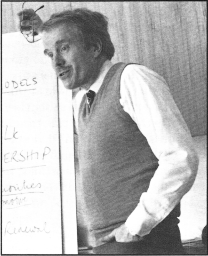
 A searchable, downloadable PDF of the original article appears below. A. Donald MacLeod is Senior Pastor of Newton Presbyterian Church in Boston, MA. He has served as Chairperson of the Renewal Fellowship in years past.
October 17, 1966. The Skyline Hotel, Toronto. A date and a place that few will recognize. Those who do will have conflicting feelings about an event, little noted, that did a great deal to shape the destinies of evangelicals within the Presbyterian Church in Canada.
Twenty-five years have gone by since that occasion: it deserves to be observed not so much for what was accomplished that day as for what it represented. At ten o’clock on the morning of October 17, 1966, for the first time a group of men (the gender was perhaps significant) met to discuss their continuing role in the Presbyterian Church in Canada.
The issue that brought them together that fall Monday was not the ordination of women. The Ninety-second General Assembly had already approved Putting Women in their Place, as Eoin MacKay had titled the original proposal. But that turning-point had made evangelicals uneasy, and the action of the Assembly in sending down for discussion a Draft Statement of Faith, and a revision of the ordination questions, caused alarm bells to ring. With it the wider question: what did it mean for Canadian Presbyterians to be bound to the Westminster Confession of Faith? Could we continue to call ourselves a confessional church with any degree of integrity? And what was our future as a separate entity forty-one years after church union, given a new burst of ecumenical enthusiasm?
“The times they are a-changing,” sang Bob Dylan. And they were changing for Presbyterians. In Canada we had reached the high-water mark of our post-war growth, with membership statistics passing the 200,000 mark for the first time since Church Union. The United Church of Canada appeared to some suspicious people to want a Canadian equivalent of the Consultation on Church Union that was drawing together the major American denominations. Confessional integrity had been the concern of some of the “stay out’ers” of 1925. Would this now be compromised?
Confessional revision was in the wind. The so-called Confession of 1967 had been proposed in the United Presbyterian Church (USA). And as Mariano DiGangi, then pastor of the Tenth Presbyterian Church, Philadelphia, warned his former Canadian colleagues:”… we are asked to adopt a document which, if unchanged before 1967, contradicts the Westminster Confession… Canadian Presbyterians will be watching their American brethren with lively interest … let everyone consider seriously the risks and responsibilities of creedal revision, and learn from the experience of others.”
Like the Confession of 1967, the Draft Statement of Faith was also the product of a theological professor. Momentum for creedal revision in the United Presbyterian Church (USA) had come from Professor E. A. Dowey, Jr., of Princeton Seminary. Similar initiatives in Canada came from Professor Joseph C. McLelland of Presbyterian College. The Draft Statement of Faith had been hastily written, and was – even more than its American counterpart – the product of a single pen. But both shared in what we now know to be a Barthian euphoria of existentialism about to eclipse. With cities and draftcards burning, reconciliation seemed an appropriate construct for Christian social engagement. Recent events in Eastern Europe and Russia today make the Marxist rhetoric of those days, both in and out of the church, seem curiously dated. With its non-inclusivist language the Confession of 1967 reads today like a historic relic. Never was there a more powerful affirmation of the statement that “He [or she] who is wedded to the spirit of one age is orphaned in the next.”
All of that was ahead. The self-styled evangelicals who gathered at the Skyline Hotel that October 17, 1966, did so with a considerable amount of ambiguity. Ever fearful of “following a divisive course,” their very assembling brought up the spectre of, at the worst, judicial action and, at the least, careers spent in ecclesiastical limbo. Even details of the meeting were to be kept confidential: it is uncertain to this day whether many know about its existence. But the gathering was a sign and a symbol of the evangelical dilemma within the Presbyterian Church in Canada.
My own involvement in those events strikes me, twenty-five years later, as curious. I was a recently ordained minister in my mid-twenties, serving an obscure parish in rural Nova Scotia. That I should be the agent by which representatives from all seven synods gathered for the first time to discuss mutual concerns, was perhaps indicative of both the strength and the weakness of evangelicals within the Presbyterian Church in Canada at that time. There was, at least in the first fifty years following church union, a remarkable openness to younger initiatives and an acceptance of men from seminaries outside the denomination. At the same time, there was a clear leadership vacuum among evangelicals in the Canadian church that made my intervention not only possible, but even welcome.
It started with a visit that I made, while in Toronto as a new member of what was then called the General Board of Missions, to Knox Church. The noon prayer meeting was then held on Fridays, and after lunch and a time of intercession, I was invited – in that wonderfully expansive way he sometimes had – to talk to Dr. Fitch in private. With all the boldness of a young upstart I asked him: “You have prayed for evangelicals in our denomination, now what are you prepared to do for them?”
As Dr. Fitch ushered me into his office, I asked if he had read the Draft Statement of Faith. He replied that he had not – the Acts and Proceedings coming out late that year. We got a copy, he read it, was visibly distressed, and asked what he could do. I had the temerity to ask him for $10,000 and the support of the Knox Session to fight it, and – perhaps even more seriously – the revision of the ordination questions.
I shall always be grateful to Dr. Fitch that he took me seriously. I am not sure that I would have been that sympathetic under similar circumstances. We were on the phone to Ian Rennie in Vancouver within minutes, and within less than half an hour in the Vestry of Knox Church a meeting had been sprung to which evangelicals across the denomination would be invited, to be held on October 17 to coincide with Ian’s trip – to the Berlin Congress on Evangelism. I shall remember Ian Rennie’s enthusiasm for setting up an organization of evangelicals nationwide, a vision that only bore fruit fifteen years later in the chartering of The Renewal Fellowship Within The Presbyterian Church in Canada.
Two great concerns were expressed as we made plans for October 17, 1966. The meeting must not be either Toronto- or clergy-dominated. Too long evangelicals had been confined to geographic and ideological ghettos. In spite of the lessons of 1925 we had, as clergy, never really developed a group of laity committed to the theological renewal of our denomination. Every synod must be represented. An equal number of clergy and laity should attend.
Returning by plane that evening to my isolated manse I realized just what I had undertaken. Fortunately Reima Bogle, Dr. Fitch’s secretary, agreed to send letters of invitation out across the country. There were practical matters too. In order to make it a truly representative meeting I had to guarantee to make up the cost of flights to Toronto by representatives from across Canada. I went to my bank manager and arranged floating a loan of the princely sum of $300! As I wrote to one friend: “I shall be in hock for the rest of my life!”
Looking back over the correspondence that flowed from my little office in First Presbyterian Church, Hopewell, Pictou County, and the rest of the church, I meet many names familiar to readers of Channels. As would be the case in many subsequent attempts to rally support, there were many surprises. One of the prominent older leaders long noted for evangelical conviction, wrote me saying he would not attend after having earlier committed himself to come. “I read (the Statement) through twice and found nothing startling in it.”
And there were the fearful. Louis DeGroot, then minister in Cooksville, Ontario, spoke for several when he wrote: “We have the precedent of Perry Rockwood and we must bear it in mind. If the formation of an organization leaves us open to the charge of following a divisive course, we could be put out of the church before we could take any effective action. In that case all we are trying to do would be of no avail, and we would be discredited in the eyes of the bulk of the people, and the cause we espouse would be discredited with us.”
It is surprising, looking back on it, that Mr. DeGroot agreed to be Chairman when his name was proposed that morning. We were thirty in number as we pulled up chairs and sat down at the green baize table with its ubiquitous pitchers of ice water and plastic cups. We had come from all eight synods. There were eleven laypeople. One of them, Doug Walker from Vancouver, had made a considerable effort to attend. At least one latecomer – Max Putnam, then of Kingston – would go on to be moderator. Several churches – particularly Knox, Toronto, with three staff members and two trustees – were heavily represented.
Looking back over the Minutes of that meeting – I served as Secretary – I note the discussion of the content of the Statement followed predictable lines. The Chair had a lot to contribute, tending to minimize its impact, and side-stepping the whole question of confessional subscription. Ian Rennie then valiantly attempted to rescue the meeting by pointing to the seriousness of the document before us. I introduced the parallel and precedent from the United Presbyterian Church (USA)’s Confession of 1967. The laity made helpful contributions: Bill Russell, then Clerk of Cooke’s Church, Toronto, Charlie Salmon of Binbrook, Ontario, and George Caldwell, then of Ottawa, each shared their anxieties, and noted that the Westminster Confession of Faith was more intelligible than the Statement. It is a verdict that, on inspection twenty-five years later, certainly is confirmed by the passage of time. The Westminster Confession reminds us that the language as well as the theology of the seventeenth century has stood up over almost three hundred and fifty years better than the vernacular of the nineteen-sixties.
The meeting then discussed appropriate responses to the Statement. A hasty telephone inquiry to The Presbyterian Record elicited a response – following quick consultations with Assembly Clerk Louis Fowler and the sponsoring Committee Chair Scarth MacDonnell – that not even a two-hundred-word article expressing concern could appear. The meeting then discussed what other steps could be taken: and a unanimous motion reaffirmed the Westminster Confession of Faith as “adequate for the needs of the Twentieth Century” but also recognized the need for a “a summation… in simple Biblical terms.” Action against the Statement was left to individuals working in the courts of the church.
A Steering Committee was established consisting of Messrs. MacRury, Fitch, Lowe, Reside and Stanford Reid, and committees were set up in British Columbia, the Prairies, Central Ontario, Montreal-Ottawa and the Maritimes. To the best of my knowledge, none of these were ever convened, and the steering committee never functioned.
What then did October 17, 1966, really accomplish? It was, at first blush, a failure. Evangelicals proved their inability to work together. The fear of any concerted action was too strong, the vacuum of leadership too great, the lack of cohesion too formidable.
But that would be too negative an assessment. Rumours of the meeting soon spread, growing as the reports circulated. The Statement never was approved, the ordination questions were substantially altered. The common sharing that October day did plant seeds. One could say that October 17, 1966, was the birth date of the Renewal Fellowship Within The Presbyterian Church in Canada.
It would be fifteen years before another attempt would be made: this time with greater ultimate success, but with evangelicals facing – as they do even today in the Canadian church – similar issues. Can we make a united, positive, and constructive contribution to the life of the church without being divisive or schismatic? How can we avoid the pitfalls of personality of empire-building? Can there be a national, lay-inspired, movement for renewal that is neither cranky nor conserving of an old order?
It took another issue – this time the so-called MacDougall case of 1979-1981 – to remind evangelicals of the danger of knee-jerk, band-aid, responses to the needs of the denomination. That case highlighted the underlying, unresolved issue that was on everyone’s mind but was never articulated that October 17, 1966: would the action of the 92nd General Assembly in allowing the ordination of women to the ruling and teaching eldership close the door forever to evangelicalism within the Presbyterian Church in Canada? How could we live with our consciences and still be true to what many of us regarded as biblical convention?
Looking over the list of those attending on October 17, 1966, one sees just how far some of us have travelled over the intervening twenty-five years. Particularly that is true of some of us who were in our twenties. Douglas Codling, then at the Scott Mission, has left the Church. Others, such as Paul Scott and Les Files, have been more closely identified with it. Bob Bernhardt has, through twenty years of faithful ministry in Hamilton, contributed his share particularly through articles in Calvinist Contact. Eventually, after a similar and more successful effort in the eighties, I left Canada altogether for ministry in the United States.
My personal direction following the collapse of the October 17th initiative was to regard the parish as a more fruitful place for evangelical influence. The founding of Bridlewood Church in November of 1967 was a direct result of my conviction that a well-trained laity and a vibrant congregation were more appropriate responses to the perilous drift of the denomination than political action. And there was also interdenominational opportunities that could preoccupy us: it is interesting how many key positions in evangelical ecumenism fell to Canadian Presbyterians between 1965 and 1975. In my case it would be the presidency of the Evangelical Fellowship of Canada and the general directorship of InterVarsity Christian Fellowship. For Ian Rennie it was first at Regent College and then, after 1981, his significant contribution as founding Dean of Ontario Theological Seminary. Only in the ’80’s did these energies find a focus within the growing Renewal Fellowship Within The Presbyterian Church in Canada.
The church of the 90’s struggles with the same issues, but its room for maneuverability is greatly decreased. The real concern we have today is with survival. The failure to grapple with theological issues – either through ignorance or fear of controversy – ultimately leads to a church without either mission or message. The mainline, now the side-line, is going to be renewed only when there is serious theological reflection. But that is true for the whole church, particularly those of us who claim Scripture as our authority.
The church today across the continent, as Chuck Colson reminds us, is “three thousand miles wide and an eighth of an inch deep.” And genuine revival of the church – which we need even more desperately in 1991 than 1966 – will come only with a restoration of its biblical and theological roots. The legacy of inaction in 1966 is with us today. If the lesson October 17, 1966 has anything to teach us it is this: that we dare not shrink from the collective need of theological reflection and radical obedience. To do any less is to ensure that in 2016 there is no church – at least as we know it – at all.
If the Presbyterian Church shrinks from its theological mandate, with its great Reformed heritage, to whom can the church catholic and evangelical look?